
What E-learning system development services are available ? These include key features that help organizations train their employees effectively
In an era where digital technology plays a crucial role in business operations, developing employee capabilities no longer needs to be limited to classroom training. Many organizations are shifting to online learning systems ( E-learning) to allow employees to learn anytime, anywhere, and to systematically track their learning progress.
According to a report on global human resource development trends, organizations with online learning systems can reduce training costs, increase course completion rates, and allow employees to access knowledge faster than traditional training methods. As a result, many businesses are starting to look for such systems. E-learning system development services Which can be designed to truly suit the organization's characteristics and business goals.
But the important question is... What E-learning system development services do you offer ? What features should an E-learning system have to meet the needs of organizations in 2026 and maximize the return on investment in learning? This article will guide you through all the key components of an E-learning system , along with guidelines for choosing the right service provider, so that businesses can sustainably enhance their workforce development.
What is E-learning ?
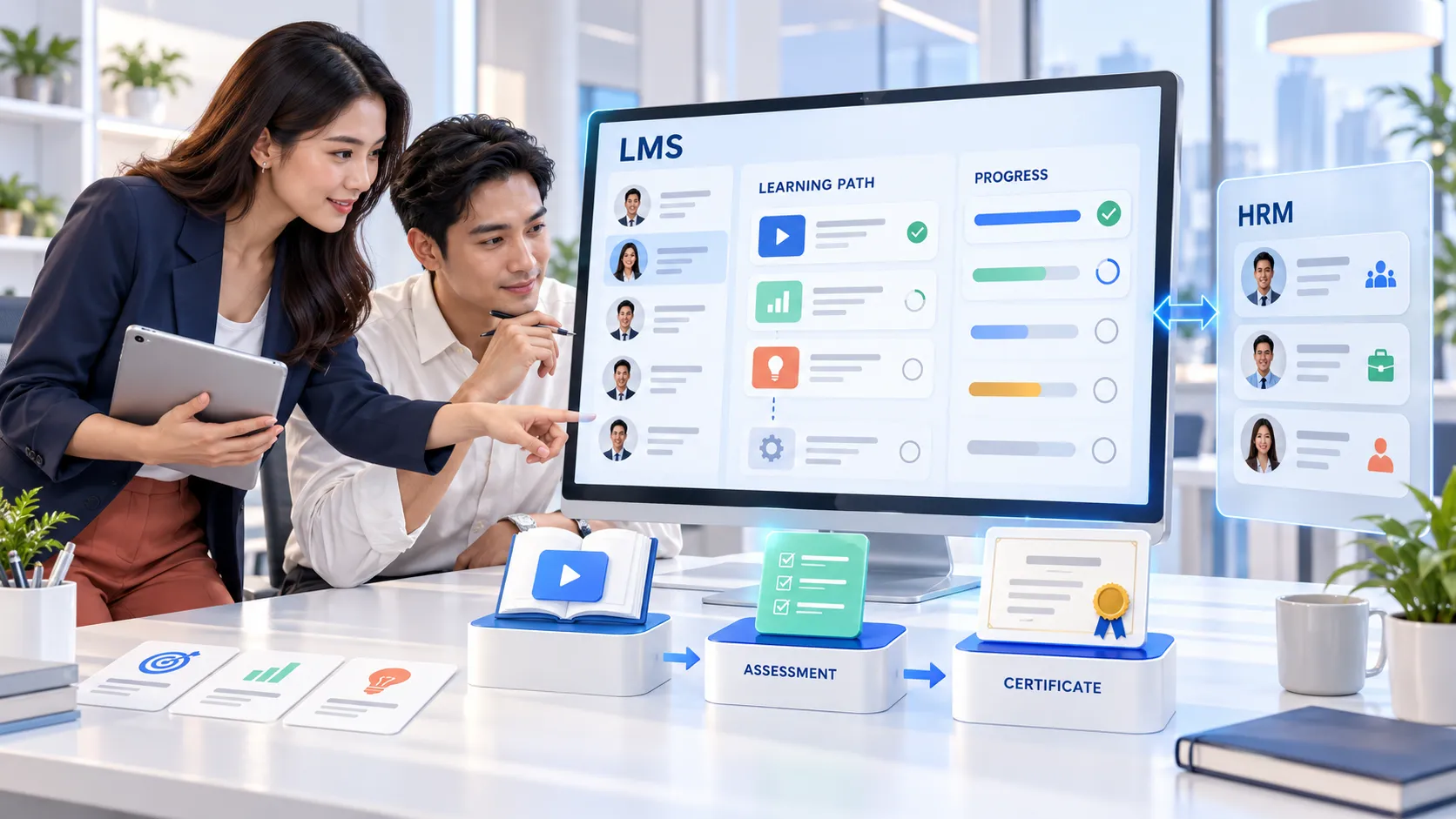
E-learning (Electronic Learning) refers to a teaching and learning system conducted through electronic media, allowing learners to access lessons via the internet or an internal organizational network without needing to travel to a training location. Nowadays, E-learning is not just a website for online learning, but also a platform that helps manage learning ( Learning Management System: LMS), covering everything from...
- Curriculum management
- Student registration
- Pre- and post-test
- Tracking student progress.
- Issuing certificates .
- Analyzing student performance through a dashboard.
- Connecting with HR systems and other organizational systems.
For this reason E-learning system development services Therefore, it continues to gain popularity in organizations of all sizes, whether private companies, factories, educational institutions, government agencies, or organizations with employees spread across many branches.
Why do modern organizations choose to use E-learning system development services?
Traditional training often has several limitations, such as travel expenses, venue rental costs, scheduling, and time constraints, preventing some employees from fully attending. Conversely, E-learning system development services It helps organizations create more flexible learning systems that are better suited to the digital age.
1. Learn anytime, anywhere ( Anywhere Learning).
Employees can access the courses via computer, tablet, or smartphone, whether they are in the office, at home, or while traveling. This results in learning not being limited by place and time, and also allows employees to review lessons whenever they want.
2. Reduce training costs.
One of the main reasons many organizations choose to use it. E-learning system development services It's about reducing costs in the long term, for example:
- Venue rental fee
- Travel expenses
- Training materials fee
- Speaker fees
- Expenses for organizing the event.
Although developing the system involves initial costs, in the long run, organizations can reuse existing courses or update content without having to start from scratch every time.
3. Establish equitable learning standards.
When an organization has employees in multiple branches or countries, providing standardized training is a challenge. E-learning systems ensure that everyone has access to the same content, the same tests, and uses the same standardized assessment criteria, allowing organizations to better control the quality of learning.
4. Track learning progress in real-time.
The system can display information such as:
- Number of students
- Duration of study
- Exam scores
- Graduation rate
- Popular courses
- Those who have not yet completed their studies.
This data helps HR and management analyze the training results and accurately improve employee development plans.
5. Support the growth of the organization.
As businesses expand, increase their workforce, or operate in multiple countries, their E-learning system can support a large number of users without increasing training costs proportionally to the number of employees. This is why medium and large-sized organizations choose to invest in... E-learning system development services To create a learning infrastructure that can grow alongside the business.
E-learning system development services to organizations.
Choice of use E-learning system development services This is not just about shifting the training format from offline to online, but also about enhancing the efficiency of knowledge management throughout the organization.
Enhance the effectiveness of employee development.
Employees can learn according to their job position, skill level, or career path, making knowledge development more specific and yielding clearer results. Organizations can also define a Learning Path to plan a sequential learning process, from foundational courses to specialized training, helping employees continuously develop their skills.
Speed up the onboarding process.
For new employees, the E-learning system can include necessary courses such as:
- Knowledge about the organization.
- Company policy
- Work regulations
- Workplace safety
- Using the internal system.
- Position-specific training
This enables new employees to learn from day one, reduces the burden on supervisors and HR , and creates a standardized, consistent on-the-job experience.
Supporting continuous learning
Successful organizations today don't just conduct training once or twice a year , but encourage employees to learn continuously throughout the year. E-learning system development services It enables organizations to quickly add new courses, update content, and disseminate knowledge, allowing personnel to continuously develop skills to keep pace with changing technology and markets.
Supporting data-driven decision-making ( Data-Driven Learning)
E-learning systems are not just platforms for online learning; they can also gather insightful data about employee learning behavior, such as popular courses, course duration, average scores, and completion rates. This information can then be analyzed to effectively improve human resource development plans.
Key features of an E-learning system development service that modern organizations should have.
Selection E-learning system development services When choosing a platform, one shouldn't focus solely on website aesthetics or video upload capabilities. Instead, they should select a platform that can support the entire organizational learning process, from course creation and progress tracking to data analysis for long-term employee development.
1. Learning Management System (LMS)
The heart of E-learning system development services is Learning Management System (LMS) Or a Learning Management System (LMS), which serves as a central hub for storing and managing all of an organization's courses. A good LMS should be manageable from the perspectives of administrators, instructors, and learners, making it convenient and efficient for all parties to use.
Essential abilities
- Categorize courses.
- Create student groups based on department.
- Define access rights.
- Manage users
- Set the study duration.
- Automatic student notification.
- Backup and security.
Organizations with an effective LMS can significantly reduce the workload of HR and training departments, while increasing the agility of organizational knowledge management.
2. Online Course Management
Another important feature of E-learning system development services It's an online course management system . The system should give administrators the flexibility to create courses, whether for new employees, departmental-specific courses, or executive courses.
Supports a wide variety of content.
- Video
- PowerPoint
- Infographic
- Audio
- Animation
- Interactive Content
- SCORM Package
- HTML5
Support for multiple file types makes learning less tedious and allows for more personalized learning experiences tailored to different target groups .
Learning paths can be defined .
The system should be able to prioritize learning, for example:
Basic course
↓
Intermediate level course
↓
Advanced course
↓
Quiz
↓
Receive a Certificate
Defining a learning path helps learners avoid skipping important steps and ensures continuous skill development.
3. Quiz and Assessment System
Learning yields clear results when the results can be measured. so E-learning system development services There should be a flexible testing system that can accommodate various evaluation methods.
The exam format that should be supported.
- Multiple Choice
- True / False
- Matching
- Fill in the Blank
- Essay
- Drag & Drop
- Random Question
- Scenario-based Assessment
The system should be able to randomly select test questions from a question bank to prevent memorized answers and increase the reliability of the evaluation results.
Pre-Test and Post-Test
Measuring performance before and after a learning experience helps organizations clearly see the progress of their employees, such as:
- Level of prior knowledge before training.
- Knowledge gained after graduation.
- Percentage of development
- Skill gap
This information helps HR plan employee development more effectively.
4. Learning Progress Tracking
One of the reasons many organizations choose to use it. E-learning system development services It is the ability to track student progress in real time. The system administrator can check immediately whether...
- Who has already started studying?
- Who hasn't studied yet?
- Who has graduated?
- Who passed the exam?
- Who failed the exam?
- How many hours of study are required?
- How often do they attend classes?
This information helps reduce the burden on HR , who no longer need to manually track learners.
Dashboard for Supervisors
Supervisors can review team information, such as:
- Graduation rate
- Average score
- Additional courses that need to be taken.
- Those at risk of not completing their studies.
This makes it possible to effectively track the team's skill development.
5. Certificate Management
After completing a training course, many organizations want to issue a certificate to confirm that employees have successfully completed the training.
so E-learning system development services There should be an automated certificate issuance system.
Essential features
- Create a Certificate Template
- Insert your organization logo.
- Specify the student's name.
- Certificate number
- QR Code for information verification.
- Date of issuance of certificate
- Certificate expiration date ( if any)
Once a learner meets the criteria, the system can generate a certificate immediately, reducing the workload for the training department and increasing convenience for learners.
Automatic notification system ( Notification System)
Another feature that shouldn't be overlooked is the notification system, which helps motivate employees to continue learning and not miss important courses.
Examples of notifications include:
- Notify me when new courses are available.
- Remind me before the class is scheduled.
- Receive a notification when the time is almost up.
- Notify exam results.
- Please notify me when you receive the certificate.
- Please renew your expired course.
The system can send notifications via email, applications, or internal organizational systems to enhance communication efficiency.
Supports integration with other systems .
Most organizations use multiple systems in combination, such as HRM, ERP , or user management systems. The choice... E-learning system development services The ability to connect to data via API will help reduce redundancy and increase data accuracy.
Examples of systems that should be connectable include:
- HRM system
- ERP system
- Single Sign-On (SSO) system
- Microsoft Entra ID (Azure AD)
- Google Workspace
- Microsoft Teams
- Zoom
- Google Meet
- Payroll system
- Performance Management System
Linking data between systems automates user account management, position-based course assignment, and learning progress tracking, significantly reducing the burden on IT and HR departments.
Advanced features of E-learning system development services and how to choose the right service provider for your organization.
Once an organization has a foundational system for online learning, what will enhance the learner experience and improve employee development are advanced features that meet the needs of digital-age learning. In particular, systems that can analyze data, personalize learning, and flexibly connect with other technologies are crucial. If you are looking for... E-learning system development services For organizations in 2026 , consider whether the system supports the following features.
6. AI Recommendation System
AI technology plays an increasingly important role in learning. Modern E-learning systems can use AI to analyze learner behavior in order to recommend courses that are suitable for each individual ( Personalized Learning).
Examples of how it works include:
- We recommend training courses tailored to your job position.
- Suggest lessons learned from the exam results.
- Identifying areas where skills are lacking ( Skill Gap).
- We recommend related courses in automation.
- Analyze the learners' interests.
The application of AI in... E-learning system development services It helps employees access knowledge that meets their needs more quickly and enables organizations to develop their personnel's potential in a targeted manner.
7. Mobile Learning
Modern learning behaviors are no longer limited to computers. Many employees want to learn via smartphones or tablets while traveling or working remotely.
so E-learning system development services It should fully support mobile learning .
Essential qualities
- Responsive Design
- Compatible with both iOS and Android.
- Accessible via web browser and mobile application.
- The system remembers the last learning position.
- Download learning materials for offline use ( if necessary).
- Supports mobile notifications.
When employees can learn anytime, anywhere, enrollment and completion rates of courses tend to increase as well.
8. Gamification
Motivating learning is another important factor, especially in organizations with large numbers of employees or those requiring ongoing training courses. Gamification is the application of game concepts to learning to make training more fun and engaging.
Examples of features include:
- Reward points
- Medals ( Badges)
- Level
- Leaderboard
- Mission or Challenge
- Daily Learning Goal
- Reward Program
These features help encourage greater student engagement with the course and reduce the drop -off rate.
9. Video Learning and Interactive Learning
Video remains a highly popular learning format, but modern E-learning systems should support more than just playing videos.
Examples of skills one should possess.
- High-definition video
- Subtitles in multiple languages
- Interactive Video
- Quiz during viewing.
- Bookmark important content.
- Adjust video speed
- Resume Learning
Additionally, interactive elements can be added , such as:
- Click to answer the question.
- Choose a simulation.
- Interactive Infographic
- Scenario Simulation
This helps learners engage with the content and remember information better.
10. Dashboard and Analytics
Data is key to human resource development in the digital age. E-learning system development services An ideal setup should include a dashboard for executives, HR , and supervisors to provide an overview of internal learning.
Examples of data that should be displayed.
- Total number of students
- Graduation rate
- Average score
- Popular courses
- Average study duration
- Skill Gap Analysis
- Learning Completion Rate
- Department Performance
- Mandatory Course Status
well-designed dashboard enables executives to make data-driven decisions and plan employee development more accurately.
Security system
Employee data and course content are considered valuable assets of the organization; therefore, the system should have standard security measures in place, such as:
- SSL Encryption
- Role-Based Access Control
- Multi-Factor Authentication (MFA)
- Data Backup
- Audit Log
- Assigning user permissions based on roles.
- Compliance with the PDPA
For large organizations, the choice should be: E-learning system development services Capable of meeting long-term data security and management standards.
The right E-learning system development service for your organization.
Even though there are many service providers in the market, not every system meets the needs of every organization. When choosing a service provider, consideration should be given to long-term business needs rather than solely comparing prices.
1. It can be customized to suit specific business models .
Each organization has different training structures, approval processes, and learning styles. Service providers should be able to design systems that align with an organization's workflow, rather than forcing the organization to adapt to off-the-shelf systems.
2. Supports organizational expansion ( Scalability)
The system should be able to support future growth, such as:
- Increase the number of users.
- Adding more branches.
- Supports multiple languages
- Supports multiple countries.
- You can add an unlimited number of courses.
- Connect to new systems in the future.
Selection E-learning system development services Being flexible helps reduce the cost of changing systems as the business grows.
3. Supports API connectivity.
The system should be able to connect to...
- HRM
- ERP
- CRM
- Microsoft 365
- Google Workspace
- Payroll
- Single Sign-On
- Business Intelligence (BI)
Linking data between systems reduces redundancy, improves data accuracy, and makes management processes more efficient.
4. We have a dedicated after-sales support and service team.
In addition to system development, service providers should have a team that can provide consultation and post-installation support, such as:
- Training on how to use it.
- Technical Support
- Bug Fix
- Preventive Maintenance
- System Monitoring
- Upgrade Version
- A clear SLA
Good after-sales service helps organizations maintain continuous system operation and reduces the risk of technical problems.
5. Experienced in Digital Transformation.
Developing an E-learning system is not just about creating a website for online learning; it should be an integral part of an organization's digital transformation. Experienced enterprise system development providers can offer better guidance on data structure design, system integration, and long-term implementation planning, enabling organizations to obtain solutions that address both technological needs and human resource development.
Trends in E-learning system development services in 2026.
By 2026, online learning will no longer be just a tool for employee training, but will become an integral part of organizational development strategies ( Learning Organizations) that enhance employee capabilities and create a competitive advantage.
Organizations that invest in E-learning system development services This will create a learning culture that provides employees with opportunities to continuously develop new skills, while keeping pace with technological changes and the ever-evolving demands of the labor market.
Key trends that are expected to gain popularity include:
AI-Powered Learning
Artificial intelligence ( AI) will play an increasingly important role in analyzing learner behavior, recommending suitable courses, and creating personalized learning paths . This will make learning more efficient and aligned with each individual's goals.
Microlearning
The course content is designed to be short and concise, with each lesson lasting only 5–15 minutes, to align with the learning habits of modern students who demand quick access to knowledge and immediate application.
Learning Analytics
Organizations will increasingly focus on analyzing learning data, using dashboards and in-depth reports to measure training outcomes such as completion rates, training duration, assessment results, and team progress. This enables management to plan skill development more accurately.
Hybrid Learning
Many organizations are integrating online and offline learning to provide employees with a flexible experience, allowing them to learn at their own pace through E-learning systems and participate in workshops or practical activities at appropriate times.
Integration Ecosystem
E-learning systems will increasingly connect with other platforms within the organization, such as:
- HRM System
- ERP System
- Performance Management
- Competency Management
- Single Sign-On (SSO)
- Business Intelligence (BI)
Connecting data between systems will help reduce redundancy, increase data accuracy, and make human resource management more efficient.
Frequently Asked Questions (FAQ)
1. What is E-learning system development service ?
E-learning system development services involve designing and developing online learning platforms that enable organizations to create, manage, and track employee training courses comprehensively, with support for learning across computers and mobile devices.
2. What types of businesses are suitable for an E-learning system ?
E-learning systems are suitable for organizations of all sizes, such as private companies, factories, educational institutions, government agencies, hospitals, retail businesses, service businesses, and organizations with employees across multiple branches or working in a hybrid and remote environment.
3. What features should an E-learning system have ?
Key features include:
- Learning Management System (LMS)
- Course Management
- Quiz & Assessment
- Learning Progress Tracking
- Certificate Management
- Dashboard & Analytics
- Mobile Learning
- Gamification
- AI Recommendation
- API Integration
4. E-learning system be integrated with the HR system ?
specially developed E-learning system can connect to HRM, ERP, Payroll, Single Sign-On (SSO), Microsoft 365, Google Workspace , and other systems via API , allowing user data and learning outcomes to integrate automatically.
5. Should organizations choose a ready-made system or develop a new one ?
If an organization has complex training procedures, requires integration with internal systems, or has specific needs, choosing... E-learning system development services A custom version ensures the system aligns with your organization's processes and can be scaled up in the future.
Summarize
Human resource development is one of the key factors driving sustainable organizational growth, and E-learning has become a primary tool enabling organizations to manage learning effectively, reduce training costs, increase flexibility, and measure learning outcomes tangibly.
Selection E-learning system development services With its comprehensive features, ranging from a Learning Management System (LMS) and course management system to online testing , dashboards and analytics, mobile learning, gamification , and AI recommendation , organizations can create learning experiences that meet the needs of employees at all levels and support long-term business growth.
Furthermore, choosing a service provider with expertise in enterprise software development ensures that the system can efficiently connect to the organization's existing infrastructure and support future expansion.
Contact us
Webpark Co. , Ltd.
525/89 Soi Ladprao 126 ( Karnporn ), Phlapphal , Wangthonglang , Bangkok 10310
Email: oraphan@webpark.co.th
Tel: 095 539 2666
Let us be your technology partner to help drive your business towards efficient management and support stable and sustainable growth in the digital age.