What is Data Management System Development Service ? A guide to systematically managing business data and supporting growth by 2026
In the era of data -driven business, " data" has become an asset as valuable as capital or human resources. Every decision, whether it's marketing planning, product development, customer management, or performance analysis, relies on accurate, complete, and up-to-date data.
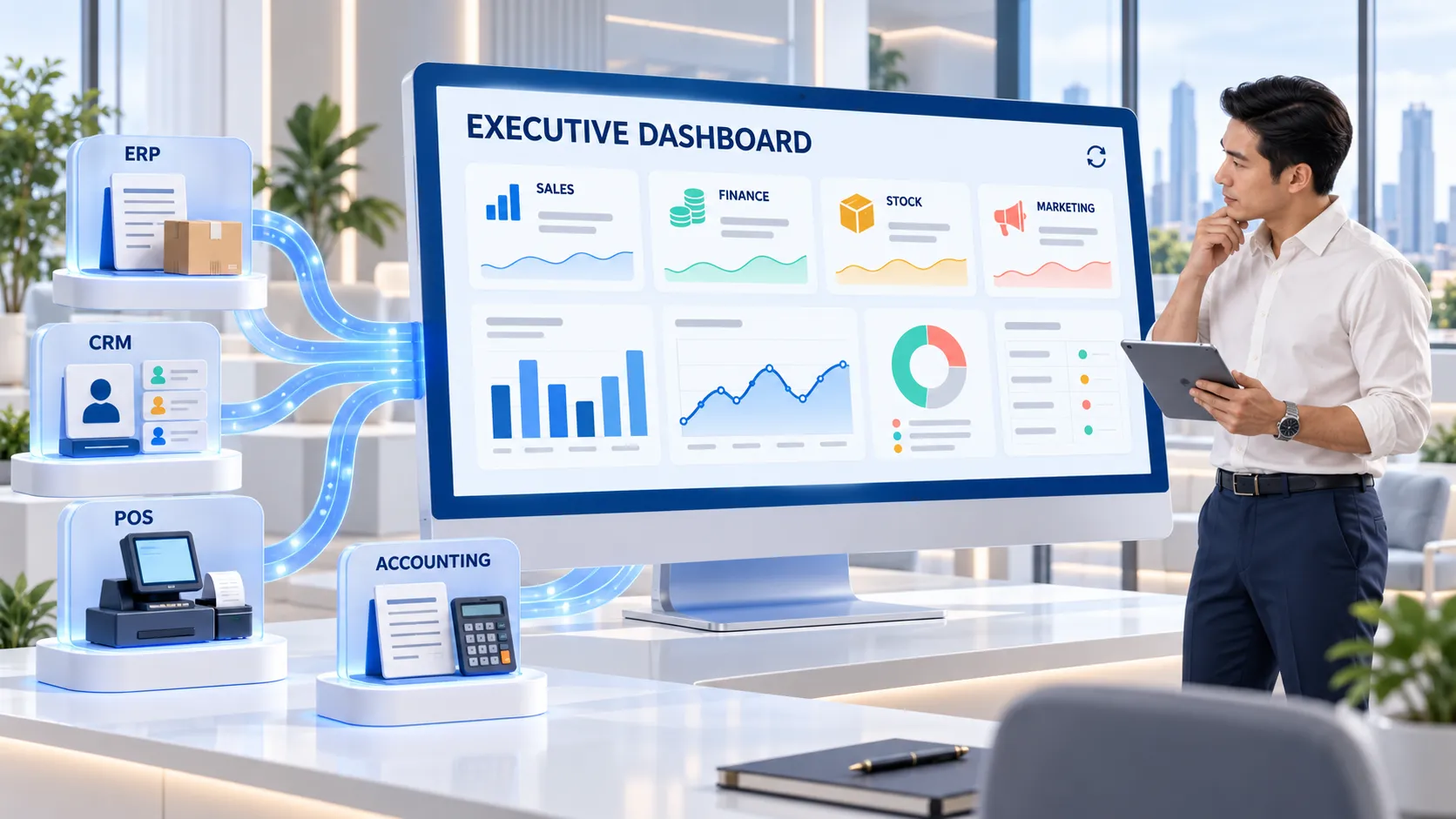
However, many organizations still face the problem of scattered data across multiple systems, such as accounting software, ERP systems, CRM systems , Excel files , or databases from each department. This results in duplicate data, inconsistencies , and time-consuming data collection and analysis. This is why... Data management system development services are expected to remain popular in 2026 because they enable organizations to collect, store, manage, and integrate data from all sources into a single system. This results in fast, secure data access and readily available data for analysis to support accurate business decision-making.
in addition Data management system development services are a crucial foundation for modern technologies such as Business Intelligence (BI), Artificial Intelligence (AI), Machine Learning (ML), Big Data Analytics , and real -time dashboards . All of these rely on high-quality data to ensure the most effective analysis and forecasting.
What is Data Management ?
Data Management is the process of managing all of an organization's data, from data collection, storage , organization, data quality management, data integration , to utilizing data for analysis and decision-making. The primary goal of Data Management is to ensure that data is accurate, complete , timely , and securely accessible .
Examples of data that organizations need to manage include:
- Customer Data
- Sales data
- Product Data
- Employee Data
- Financial Data
- Marketing data
- Information from websites and applications.
- Data from IoT or Smart Devices.
When all data is organized systematically, businesses can use it to create reports, analyze trends, and develop strategies more effectively.
Why do businesses need to focus on Data Management in 2026 ?
Organizations today must cope with a massive amount of data that increases every day, from websites, applications, social media , ERP systems , CRM systems , POS systems , and various cloud platforms. Without a good data management system, various problems can arise, such as:
The data is scattered across multiple systems.
Each department uses different software, resulting in disconnected data and requiring time to manually gather information.
Duplicate and inaccurate information.
The same customer's data may be entered multiple times, leading to errors in analysis and communication.
It took a long time to write the report.
Many organizations still need to export data from multiple systems to Excel for data consolidation, which is time-consuming and prone to human error .
Inaccurate decision making.
When information is incomplete or outdated, management may make decisions based on incorrect data, impacting sales, costs, and business planning.
Data security risks
Data that lacks defined access rights or a backup system can lead to the leakage of critical data and business damage.
As a result, many organizations have begun investing in... Our data management system development services create a robust data infrastructure to support long-term growth and prepare organizations for the adoption of AI and advanced data analytics.
What is Data Management system development service ?
This service designs, develops, and customizes data management systems to suit the specific operational needs of each organization. The goal is to ensure that data from all sources can be efficiently interconnected, reducing redundancy, increasing accuracy, and supporting in-depth data analysis.
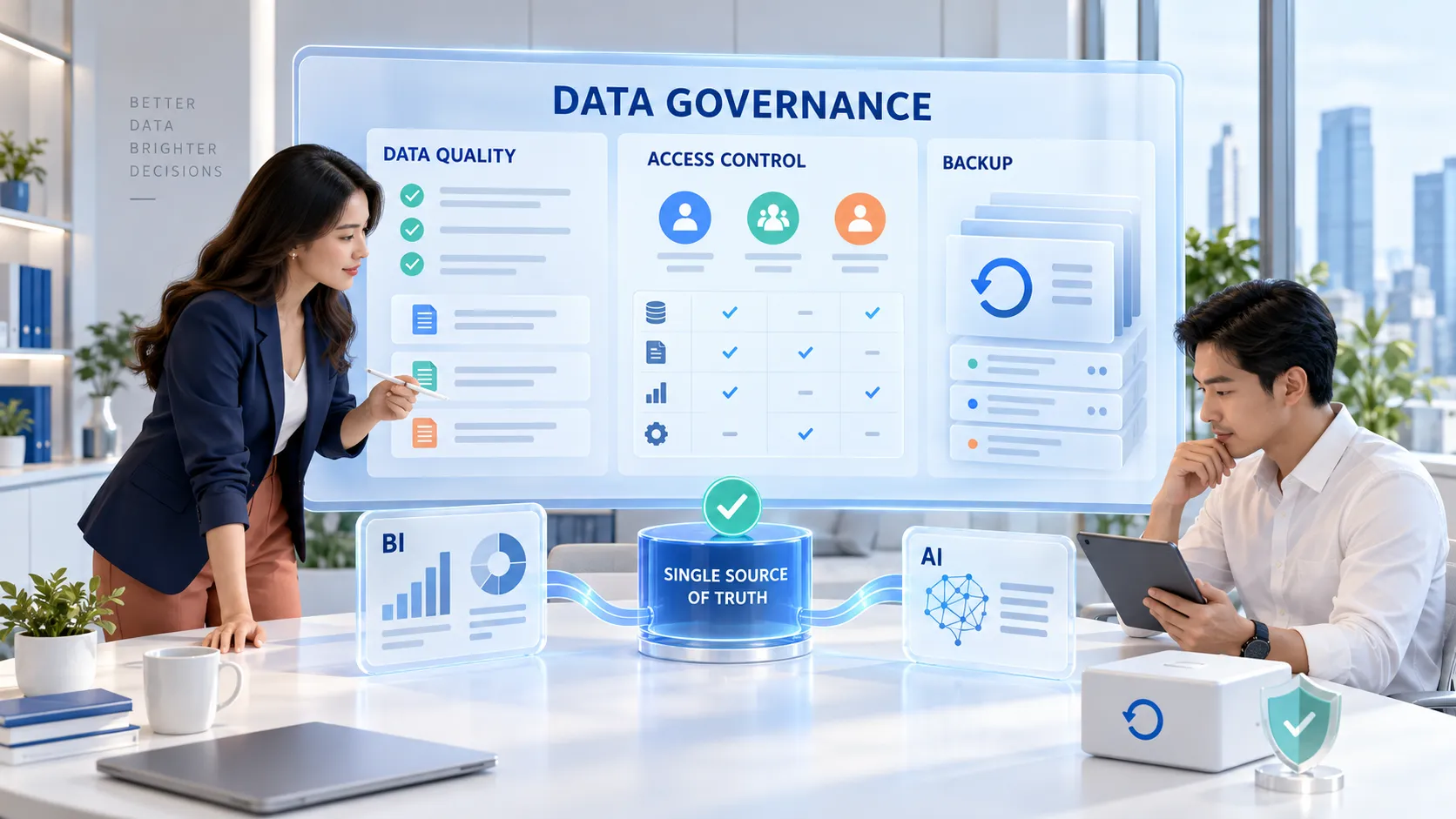
The service provider will begin with an analysis of the organization's existing data structure ( Data Assessment) , designing the data architecture ( Database Architecture) , establishing the database system ( Database Design) , developing data connectivity ( Data Integration) , and defining data management standards ( Data Governance) so that all departments can use the same set of data ( Single Source of Truth).
in addition Our data management system development services can also connect to various key systems within the organization, such as:
- ERP (Enterprise Resource Planning)
- CRM (Customer Relationship Management)
- HRM and Payroll
- Accounting System
- Warehouse Management System
- E-commerce system
- Marketing Automation
- Business Intelligence (BI)
- Real -time dashboard
- AI and Machine Learning Platform
Linking this data helps reduce redundant workflows, increases data access speed, and enables executives to gain a comprehensive overview of the business through accurate and up-to-date information. Furthermore, Our data management system development services can also be designed to support future organizational expansion, whether it's adding branches, integrating new systems, migrating data to the cloud , or handling massive amounts of data ( Big Data). This allows businesses to grow sustainably without needing major system restructuring later on.
The benefits of data management system development services that businesses shouldn't overlook.
As data becomes central to business operations, having an effective data management system is not just about storing data, but about building a strong foundation for the organization in the long term. Data management system development services enable all parties to use the same data set, reducing errors and significantly enhancing competitiveness.
1. Centralize data from all sources into a single central location .
Many organizations have data stored in multiple systems, such as:
- ERP system
- CRM system
- Accounting system
- HRM system
- Websites and E-commerce
- Mobile Application
- Social Media
- IoT Devices
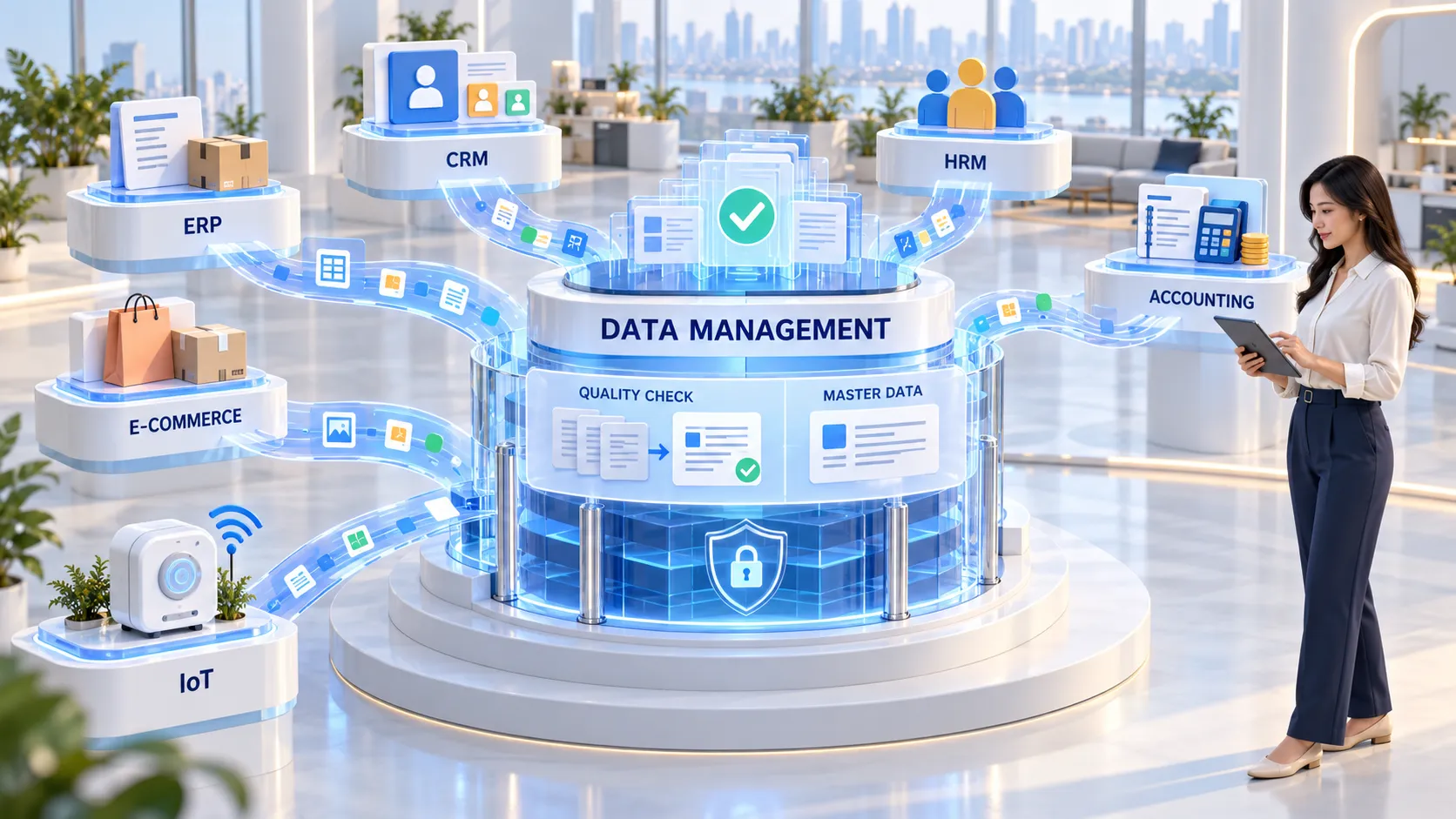
If each system operates in isolation, it creates data silos , or "data confined to each department," making it difficult to analyze the overall business landscape. Our data management system development services help consolidate data from all sources into a single central hub, enabling all parties to access accurate and up-to-date information from a single source of truth.
2. Reduce data redundancy and improve data quality .
One of the common problems is that the same customer's information is entered multiple times, or there are inconsistencies between different systems.
For example,
- The sales department uses a version of the company name.
- The accounting department uses a different name.
- The customer service department keeps another set of data.
When the data is inconsistent, the analysis or reporting will be inaccurate.
data management system will help.
- Double check the information.
- Automatic data aggregation.
- Define data standards.
- Verify the information before saving.
This ensures the organization has clean data that is readily available throughout all processes.
3. Increase the speed of data analysis.
Many organizations also spend hours or days gathering data to prepare reports.
Example of the original process.
- Export data from ERP.
- Export data from CRM.
- Export data from Excel.
- Gather data manually.
- Double check the information.
- Create a new graph each time.
But when used... Data Management System Development Services All data is automatically linked, enabling the creation of real-time reports and dashboards. This allows management to instantly track sales, profits, inventory, and marketing campaign performance.
4. Supporting Data -Driven Decision Making
Organizations that succeed in the digital age don't make decisions based solely on feelings, but use data as the foundation for defining their strategies.
Examples of usage include:
- Analyze best-selling products.
- Forecasting future sales.
- Analyze customer behavior.
- Stock planning.
- Planning personalized marketing strategies .
- Evaluate the return on investment ( ROI).
When information is accurate and complete, management decisions become more precise, risk is reduced, and opportunities for profit are increased.
5. Support future business growth.
As an organization expands its branches, increases its customer base, or develops new sales channels, the volume of data increases rapidly. A system that is not designed to accommodate scalability may cause problems such as:
- The system is running slower.
- The database cannot handle such a large amount of data.
- We need to migrate the entire system.
data management system development service will design a scalable data structure ( Scalable Architecture) that can accommodate increasing users, integrating new systems, and managing large datasets ( Big Data) without impacting organizational operations.
Key features that a data management system should have.
Choice of use Data management system development services should not only consider the ability to store data, but also features that help utilize data to its full potential.
Data Integration
Data can be connected from multiple systems via API or ETL (Extract, Transform, Load) to automate data flow, reduce data duplication, and minimize errors from manual work.
Data Governance
Establish standards for data storage, access rights, and usage policies to ensure data security and compliance with organizational requirements.
Master Data Management (MDM)
Manage core organizational data, such as customers, products, partners, and employees, to create a single, accurate set of information, reducing confusion between departments.
Data Quality Management
It checks data quality, such as completeness, accuracy, consistency, and timeliness, and provides alerts when anomalies are found.
Data Warehouse and Data Lake
It supports the storage of both structured and unstructured data, preparing it for in-depth data analysis and AI applications.
Dashboard and Reporting
Display data in real-time via a dashboard with easy-to-understand graphs, charts, and reports, enabling management to quickly track performance.
Security and Access Control
Implement role -based access control , along with data encryption and audit logs to enhance security.
Backup and Disaster Recovery
Automatic data backup and a data recovery plan in case of unforeseen events reduce the risk of losing important data.
What other systems can the Data Management system connect to ?
One of the highlights of Data management system development services provide the ability to seamlessly connect and integrate data from various systems. This allows organizations to build upon their existing infrastructure without needing to completely replace their existing systems.
Examples of systems that can be connected include:
ERP (Enterprise Resource Planning) system
Integrating financial, purchasing, production, warehousing, and sales data provides executives with a comprehensive overview of the business within a single system.
CRM (Customer Relationship Management) system
Gathering customer information, purchase history, contact details, and marketing activities helps sales and customer service teams provide efficient service.
Accounting and financial systems
Link revenue, expense, invoice, and financial statement data to reduce data entry redundancy and improve the accuracy of financial information.
HRM and Payroll System
The system aggregates employee data, timekeeping, leave requests, and salaries, allowing the Human Resources department to manage information from a central location.
E-commerce and Marketplace
Connecting orders, inventory, and customer data from multiple channels helps to manage online sales more efficiently.
Business Intelligence (BI)
data from Data Management using BI tools to create dashboards and insightful reports that support executive decision-making.
AI and Machine Learning
Systematically processed data is of sufficient quality for use in developing AI models , forecasting business trends, and predictive analytics .
What types of businesses should utilize data management system development services?
Many people may understand that... Data management system development services are often perceived as suitable only for large organizations. However, in reality, small and medium-sized enterprises ( SMEs) and large corporations can all benefit from systematic data management, especially in an era where data plays a crucial role in business operations and competitiveness.
1. Retail business .
Retail businesses need to manage a lot of data, such as:
- Product information
- Stock information
- Sales data
- Member information
- Promotion information
- Information from multiple fields.
Usage Our data management system development service will help connect all data together, enabling accurate analysis of best-selling products, inventory forecasting, and promotional planning.
2. E-commerce business
Online stores often obtain information from multiple sources, such as:
- website
- Marketplace
- Social Commerce
- Payment system
- Delivery system
Without a good data management system, problems such as inaccurate stock counts, mismatched sales figures, or duplicate customer data will occur. A data management system will help ensure that data across all channels is automatically updated, reducing errors and enhancing the customer experience.
3. Factory and industrial businesses.
The factory needs to manage information about...
- Production
- raw material
- machinery
- Product quality
- warehouse
- supply chain
By linking all the data together, it can help reduce costs, increase production efficiency, and enable faster analysis of problems in the production line.
4. Financial and insurance businesses.
Financial organizations must handle sensitive data and face high security requirements.
Examples of data include:
- Customer information
- Transaction data
- Supporting documents
- Contact history
- Risk assessment
Data management system development services help securely store data, define access rights, and allow for monitoring past data usage history.
5. Hospitals and healthcare businesses.
Public health agencies have to manage large amounts of data, such as:
- medical records
- Test results
- Appointment
- Medical history
- Disbursement information
data management system helps reduce data redundancy, increases the speed of data retrieval, and supports efficient patient care.
6. Government agencies and large organizations.
Organizations with multiple departments or branches often face the problem of scattered information. The use of... Data management system development services help create a unified data standard across the organization, enabling efficient data exchange and reporting.
Data Management system development service provider.
Investing in information systems is a long-term investment, so choosing a service provider with expertise is a key factor in the success of the project.
1. Experienced in system analysis and design.
Service providers should begin by studying the organization's workflows, analyzing existing data structures, and designing systems tailored to the business, rather than using a one-size-fits-all solution for every organization.
2. Capable of developing custom systems for the organization .
Each business has different data formats and workflows. A customizable system can help organizations maximize benefits.
3. Supports integration with legacy systems.
Most organizations already have ERP, CRM , or accounting systems in place. Service providers should be able to connect data via API or middleware without having to completely overhaul the existing systems.
4. Prioritize data security.
The system should have security measures in place, such as:
- Data Encryption
- Multi-Factor Authentication (MFA)
- Role-Based Access Control
- Audit Log
- Data backup system
- Disaster Recovery
To prevent the risk of data loss or unauthorized access.
5. Supports business expansion.
A good system should be able to accommodate future increases in users, branch expansion, integration with new systems, and increased data volumes without needing to replace the entire system.
6. After-sales service and support team are available.
Post-installation support, such as user training, system maintenance, version updates, and troubleshooting, helps organizations maintain system continuity and value for their investment.
Mistakes organizations should avoid in data management.
Even if an organization invests in technology, without proper planning, the project may fail.
They view Data Management as simply a system for storing data.
In reality, data management encompasses data standardization, data linking, data quality maintenance, and the use of data to create business value.
There is no central data standard.
If each department defines its own data format, it will lead to inconsistencies and make it difficult to link data.
Neglecting data quality.
Even with the most advanced analysis systems, inaccurate data cannot produce precise results. A widely accepted principle in the data field is "Garbage In, Garbage Out (GIGO)" : if the source data is of poor quality, the analysis results will inevitably be inaccurate.
No data access permissions are specified.
No type of information should be accessible to everyone. Defining access rights based on roles and responsibilities helps enhance security and reduce the risk of data breaches.
Lack of future planning.
Many organizations choose systems that meet their current needs, but as the business grows, they often cannot accommodate the volume of data or new system connections, resulting in reinvestment in a short period of time.
Data Management Trends in 2026
Information technology is evolving rapidly, and organizations that can manage data effectively will have a greater competitive advantage. Interesting trends include:
AI-Driven Data Management
AI will help check data quality, analyze anomalies, categorize data, and automatically suggest ways to improve data, reducing the workload of IT teams and increasing accuracy.
Cloud-Native Data Platform
Organizations are increasingly migrating their data storage systems to the cloud to increase flexibility, reduce infrastructure costs, and facilitate business expansion.
Real-time Data Processing
real-time data, whether it's sales figures, inventory, or customer behavior, to enable them to make quick decisions and respond to situations effectively.
Data Governance and Data Compliance
With stricter data protection laws and standards, organizations must prioritize establishing systematic data management policies, access control, and data usage audits.
Data Fabric and Data Mesh
The concept of linking data from multiple systems without having to migrate all the data is gaining popularity. This allows organizations to easily access data from various sources while reducing the complexity of managing data structures.
Integrating Data Management with AI and Business Intelligence.
By 2026, many organizations will leverage well-managed data in conjunction with AI, Machine Learning , and Business Intelligence to create in-depth analytics, predictive analytics , and prescriptive analytics , thereby enhancing business competitiveness and creating new growth opportunities.
Frequently Asked Questions ( FAQ)
1. What is Data Management System Development Service ?
Data Management system development services involve designing and developing systems for collecting, storing, linking, and managing organizational data in a standardized format, ensuring secure access, and enabling analysis to support effective business decision-making.
2. What types of businesses should use data management system development services?
Almost any business that stores data can use this system, such as:
- Retail business
- E-commerce
- industrial plants
- logistics business
- Real estate business
- hospital
- Educational Institutions
- Banks and financial institutions
- Government agencies
- Medium and large organizations
If an organization has data from multiple departments, systems, or branches, using Data management system development services can greatly reduce the complexity of data management.
3. How does Data Management differ from Database Management ?
A database is a place for storing data, while data management is the entire process of managing that data. This includes everything from collection and quality control to linking, storing, defining access rights, and analyzing and utilizing the data. Therefore, a database is only one component of data management.
How does data management help improve organizational efficiency ?
The organization will benefit in several ways, such as:
- Reduce data redundancy.
- Improve the accuracy of the data.
- Link data from all systems.
- Reduce the time spent preparing reports.
- Supports real -time dashboard .
- AI and Business Intelligence applications .
- Increase the speed of executive decision-making.
5. Can the Data Management system integrate with the organization's existing systems ?
Yes, the system can connect to ERP, CRM, HRM, Payroll, Accounting systems , websites , mobile applications, e-commerce systems , and cloud platforms via API or middleware , allowing organizations to build upon existing systems without needing to start from scratch.
6. Is investing in a data management system worthwhile ?
For organizations with large amounts of data, investing in... Data management system development services are a long-term investment because they help reduce costs from redundant work, minimize data errors, increase operational efficiency, and create opportunities to leverage data for future business development.
Data management system development ?
Developing a data management system is not just about creating a database; it requires an understanding of each organization's processes, data architecture design, system integration, data governance , and planning for long-term business growth.
Choosing an experienced service provider will help organizations obtain a system that meets their actual needs, reduce investment risk, and allow for future system expansion without starting from scratch.
One of the service providers specializing in enterprise software development is… Webpark Company Limited They provide comprehensive digital system design and development services, focusing on analyzing customer needs to develop solutions tailored to each business. The team of Webpark Company Limited I have experience developing systems for a wide variety of organizations, including:
- ERP system
- CRM system
- HRM system
- Customer Management System
- Dashboard and Business Intelligence Systems
- Big Data system
- Data Integration System
- Data Management System
- Web Application
- Mobile Application
- Custom Software Development
Furthermore, the team prioritizes designing a system that can connect to modern technologies, support cloud computing , enhance data security, and scale to grow with the business in the future. This helps organizations utilize data to create business value to its full potential.
Summarize
By 2026, data will not just be a resource that organizations store, but a critical factor impacting competitiveness, strategic planning, and innovation. If data is accurate, interconnected, and readily available, organizations can make faster decisions, reduce costs, and respond effectively to market changes.
Choice of use Data management system development services are an investment that lays the foundation for an organization's data, covering aspects such as data storage, management, quality assurance, data integration across multiple systems, and further development towards Business Intelligence, AI , and in-depth data analysis.
No matter what industry your business is in, if you want to become a data-driven organization, start with... Our data management system development services , tailored to your organization's operational needs, will help improve efficiency, create a competitive advantage, and support sustainable long-term business growth.
If you are looking for experts in designing and developing systems that meet your organization's needs. Webpark Company Limited We offer consulting services, analyze your needs, and develop solutions tailored to your business, transforming data into strategic resources that create tangible value and results.
Contact us
Webpark Co. , Ltd.
525/89 Soi Ladprao 126 ( Karnporn ), Phlapphal , Wangthonglang , Bangkok 10310
Email: oraphan@webpark.co.th
Tel: 095 539 2666
Let us be your technology partner to help drive your business towards efficient management and support stable and sustainable growth in the digital age.