ERP System Development Services
In 2026 , the business world is changing rapidly, and many entrepreneurs are asking themselves: What type of business is suitable for ERP accounting system development services? Because an ERP system is not just accounting software, but a "digital infrastructure" that helps businesses of all sizes operate efficiently. And when connected with experts such as... Webpark Company Limited This further enhances the ability to perfectly meet all the requirements of using ERP .
ERP Accounting ( Enterprise Resource Planning for Accounting) is a system that integrates financial management, accounting, cost analysis, and data integration with other systems such as sales, production, and service. This enables businesses to reduce errors, increase accuracy, and create a competitive advantage.
ERP and why will it be important in 2026?
ERP accounting is not just accounting software, but a system that connects data from all parts of the organization, from... Sales , production , service. All the way to Finance and Accounting
By 2026, technologies like AI, Big Data , and Cloud Computing will play a more significant role. Businesses seeking a competitive advantage will need to utilize ERP and accounting systems to manage data efficiently and meet various needs. SEO and AEO Because accurate and timely information is key to competing in the digital age.
ERP accounting system development services?
1. SME businesses
SMEs often have limited resources . Manual accounting or basic software can lead to errors. ERP accounting helps SMEs reduce complexity, increase accuracy, and enable better cost analysis.
2. Medium-sized businesses
Expanding businesses need systems to support their growth. Accounting ERP systems help to systematize data management and can link data across multiple departments.
3. Large businesses
Organizations with multiple departments and branches require a system capable of integrating data. Accounting ERP systems enable executives to view financial data in real-time and make accurate decisions.
4. Service businesses.
For example, consulting firms, hotels, or educational institutions that need an efficient expense and revenue management system, ERP accounting helps to track income and expenses in detail.
5. Manufacturing business
Manufacturing businesses need to control costs and link production data with ERP accounting systems . Accounting allows for accurate analysis of production costs and reduces losses.
Integrating the accounting ERP system with various modules
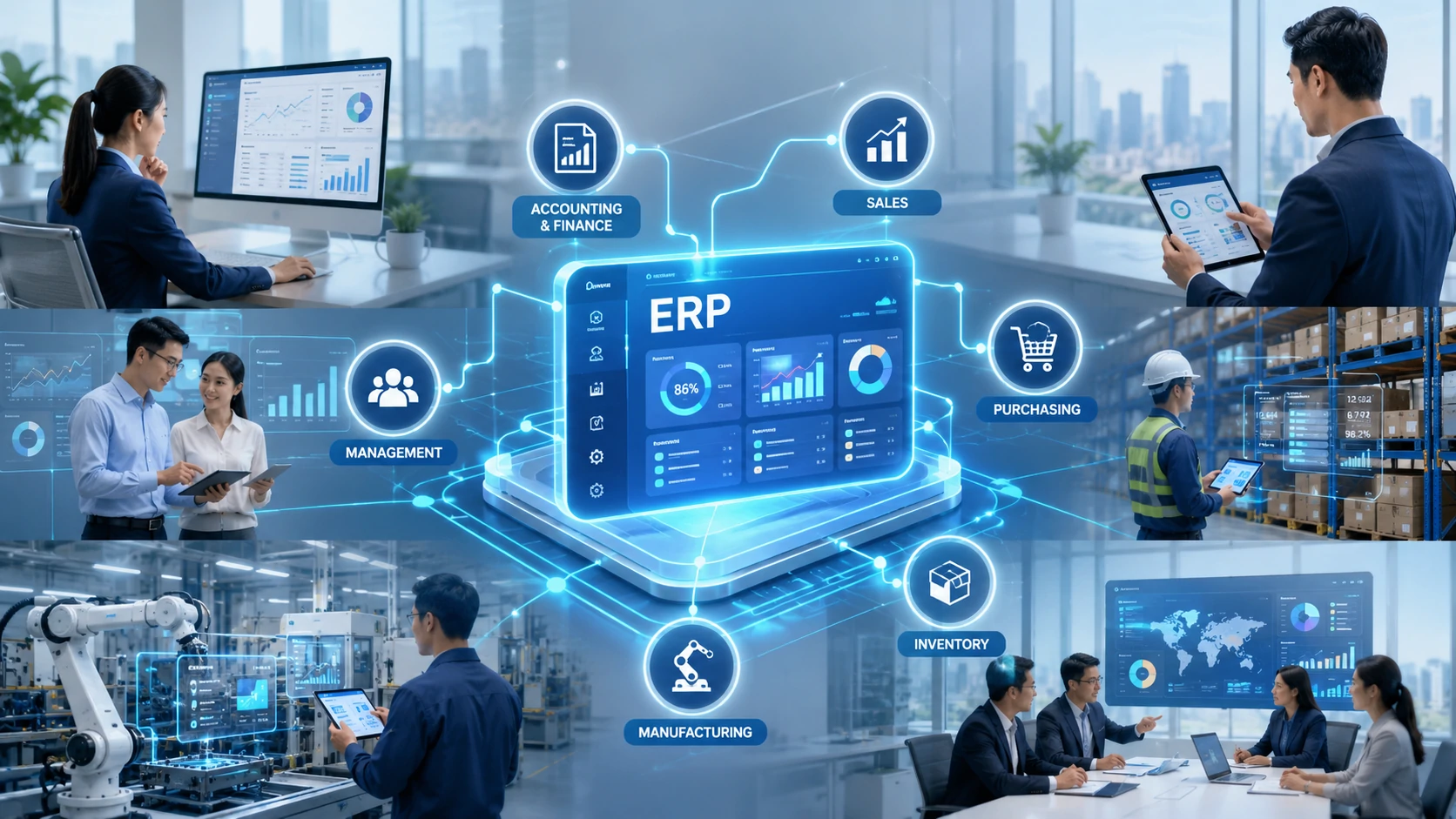
We can see that ERP is not limited to accounting but covers the management of the entire organization, such as:
- Warehouse system : Record goods received , goods withdrawn , stock check , inventory report.
- Sales system : Quotation, Sales Order, Delivery Order, along with sales reports.
- Purchasing system : Purchase Request, Purchase Order, Purchase Cost Report.
- Accounting system : Accounts Payable , Accounts Receivable , General Ledger, Sales and Purchase Tax.
- Cost Accounting System : Cost Allocation , Actual Cost Calculation , Stock Card Pricing
- Production systems : MRP, MPS, Production Control, Bill of Material, Production Monitoring
- Quality control system : Inspects raw materials and finished products.
Integrating these modules with accounting ERP enables businesses to comprehensively control costs, track production, and manage finances.
for A full-fledged enterprise accounting system for a business . A listed automotive parts manufacturer (TAM ) must not only have accounts payable and receivable, but also integrate its entire organization's ERP system, encompassing purchasing, production, warehousing, sales, accounting, finance, taxation, and compliance, in accordance with stock exchange auditing standards.
ERP system actually used in industrial-level organizations
For manufacturing businesses, especially automotive parts manufacturers or large organizations, an ERP system for accounting and finance is not just about recording income and expenses. It must also connect data from all departments within the organization, from purchasing and production to warehousing, sales, finance, taxation, and overall organizational management, in a comprehensive manner.
In practical system structures, they are typically divided into: 10 main groups As follows:
1. Financial Accounting (GL)
Financial accounting system (the heart of the accounting system)
Financial Accounting , or General Ledger (GL), is the central hub for all financial information within an organization. It serves to consolidate accounting entries from all modules into a central accounting system.
General Ledger (GL)
- Chart of Accounts
- General Ledger
- Journal Voucher
- Recurring Journal
- Budget Control
- Multi-Company
- Multi-Currency
- Consolidation
- Cost Center
- Profit Center
Compliant with standards and audits.
- TFRS
- IFRS
- SOX Control
- Audit Trail
2. Accounts Payable (AP)
Accounts Payable Management System
Helps manage debt and payment obligations to suppliers efficiently .
Vendor Management
- Supplier information
- Credit Term
- Withholding tax
AP Transaction
- Purchase Invoice
- Debit Note
- Credit Note
- Payment Voucher
Payment Management
- transfer money
- check
- E-Payment
- Bank Interface
3. Accounts Receivable (AR)
Accounts Receivable Management System
Used for tracking revenue, issuing sales documents, and receiving payments from customers.
Customer Management
- Customer Master
- Credit Limit
- Aging
Billing
- Invoice
- Tax Invoice
- Debit Note
- Credit Note
Collection
- Receipt
- Customer Payment
- Bank Receipt
Analysis & Reporting
- Aging Report
- DSO (Days Sales Outstanding)
- Collection Report
4. Cash & Bank Management
Cash and banking management system
It helps control financial liquidity and monitor cash flow within an organization.
Bank Reconciliation
- Affect automated bank balances.
Cash Flow Management
- Daily Cash Position
- Cash Forecast
Treasury Management
- loan
- interest
- LC (Letter of Credit)
- BG (Bank Guarantee)
5. Fixed Asset Management
Fixed Asset Management System
Large factories and organizations have numerous assets, so they need a systematic system for tracking and managing them.
Asset Register
- machinery
- Tooling
- Mold
- building
- car
Depreciation
- Straight Line
- Tax Depreciation
Asset Control
- Transfer
- Disposal
- Asset Audit
6. Cost Accounting ( Very important)
Cost accounting system for manufacturing plants.
This module is crucial for the manufacturing business, especially the automotive parts industry.
Cost Center
- Production
- QA
- Warehouse
- Engineering
- Maintenance
Costing Structure
Material Cost
- raw material
Labor Cost
- wage
Overhead Cost
- Electricity bill
- depreciation
- Machinery cost
Product Cost
- Cost per piece
Standard Cost
- Standard cost
Actual Cost
- Actual cost
Variance Analysis
- Material Variance
- Labor Variance
- Overhead Variance
7. Manufacturing Accounting
Accounting systems linked to production.
Help connect cost data directly to the production process.
BOM (Bill of Material)
- Raw Material
- Semi-Finished
- Finished Goods
Production Order
- Work Order
- Job Costing
WIP (Work In Process)
Track production status.
- Incoming raw materials
- Produced
- waste
Yield Analysis
- Scrap
- Defect
- Rework
8. Inventory Accounting
Inventory accounting system
This is another important module for manufacturing businesses that need to manage large amounts of raw materials and inventory.
Inventory Valuation
- FIFO
- Moving Average
- Standard Cost
Stock Control
- Raw Material
- WIP
- Finished Goods
Inventory Transaction
- GRN
- Issue
- Transfer
- Adjustment
Cycle Count
- Physical Count
- Stock Reconciliation
9. Tax Management
Tax administration system
It helps ensure that tax calculations and documentation are done correctly and legally.
VAT
- Input VAT
- Output VAT
WHT
- Form PND. 3
- Form PND. 53
Corporate Tax
- Deferred Tax
- Current Tax
e-Tax
- e-Tax Invoice
- e-Receipt
10. Corporate Reporting & Compliance
Reporting and Corporate Governance System
Suitable for large organizations and publicly traded companies that need to comply with auditing standards.
Financial Statement
- balance sheet
- Profit and Loss Statement
- Cash flow statement
- Statement of Changes in Equity
Consolidation
- Consolidate financial statements of multiple companies.
Audit
- Internal Audit
- External Audit
Compliance
- SOX
- ISO 27001
- ISO 9001
- IATF 16949
ERP module that needs to be linked to the accounting system.
For complete enterprise-wide data management, the accounting system needs to be connected to the following modules:
Procurement
- PR
- RFQ
- PO
- Receiving
Warehouse
- Inventory
- Barcode
- RFID
Manufacturing
- MRP
- BOM
- Production
Quality
- Incoming QC
- In-process QC
- Final QC
Maintenance
- PM
- Breakdown
- Machine History
HR & Payroll
- salary
- OT
- Cost Allocation
Executive Dashboard ( CFO Dashboard)
Data from all modules will be analyzed and displayed via a dashboard to help executives make quick decisions.
Financial KPI
- Revenue
- Gross Profit
- EBITDA
- Net Profit
Manufacturing KPI
- OEE
- Yield
- Scrap Rate
Working Capital
- Inventory Turnover
- DSO
- DPO
Cash Flow
- Cash Position
- Forecast
Why is 2026 a year of change?
2026 will be a year of significantly increased business competition. Using an ERP accounting system is n't just about making work easier, but also about creating a competitive advantage. Businesses are asking: " What type of business is suitable for ERP accounting system development services ?" The answer will be, "Every business that requires accuracy, speed, and sustainable growth."
Benefits of using Accounting ERP
- Cost reduction By reducing errors and redundancy.
- Increasing accuracy In accounting and data management.
- Data linking Between departments
- Cost analysis Accurate and timely.
- Quick decision making With real-time data.
Real-world usage examples
- SMEs that use ERP accounting systems can reduce accounting time by over 40% .
- Manufacturing businesses that use ERP accounting systems can reduce production costs by more than 20% .
- Service businesses, such as hotels, can track revenue and expenses in real-time, leading to more efficient management.
Summarize
If you are looking for the answer to... What type of business is suitable for ERP accounting system development services? The answer is, "Every business that wants to manage financial data efficiently and be ready to compete in 2026."
Integrating an ERP accounting system with modules such as warehousing, sales, purchasing, production, and quality control will enable businesses to achieve stable growth and gain a competitive advantage in a highly competitive market. If you need a reliable partner, a company... WebPark Co., Ltd. That is the most appropriate answer.
If your organization is looking for a comprehensive ERP, accounting , inventory , procurement, or business management solution, the expert team at Webpark Co., Ltd. is ready to provide consultation, design, and development services to align with your business processes, thereby improving operational efficiency and supporting long-term growth.
We are ready to provide advice on ERP system implementation, data integration between departments , real-time reporting , and developing customized systems to meet the specific needs of your organization.
Contact us
Webpark Co. , Ltd.
525/89 Soi Ladprao 126 ( Karnporn ), Phlapphal , Wangthonglang , Bangkok 10310
Email: oraphan@webpark.co.th
Tel: 095 539 2666
Let us be your technology partner to help drive your business towards efficient management and support stable and sustainable growth in the digital age.